
Test-Informed Pain Management: Using Objective Data
Test-informed pain management means your treatment plan starts from measured information, not from a pain score and a guess. Questionnaires, a physical exam and imaging each add a piece. A blood test that looks at immune system markers adds one more: a biological reading you and your doctor can point to. The Pain Signal Test™ is built for that purpose. It is a blood draw that measures immune markers linked to chronic pain, so your next conversation with your provider starts from data.
TL;DR
- Test-informed pain management combines your history, exam, pain questionnaires and diagnostic tests to guide treatment, rather than relying on a 0 to 10 pain rating alone.
- Pain scales are subjective by design. Objective measures, such as inflammatory markers in blood, give your care team something to compare against over time.
- Research links inflammatory markers such as CRP, IL-6 and TNF-α with chronic musculoskeletal pain, which is why immune factors belong in the conversation.
- The Pain Signal Test™ is a simple blood draw built on peer-reviewed DNA research from a leading U.S. university. Patients covered by Medicare or PPO insurance typically pay nothing out of pocket.
- Bring your results to your doctor. They turn a vague complaint into a specific discussion about next steps.
Table of Contents
- What “test-informed” pain care actually means
- The tools in use today
- Why a pain score alone leaves gaps
- Where immune markers come in
- How clinicians put results to work
- Reading your results with your doctor
- For providers: adding a biological layer
- Getting the test
- FAQ
- Sources
What “test-informed” pain care actually means
Chronic pain is usually defined as pain that lasts more than three months. Most people living with it have been through the same loop: describe the pain, rate it, try a treatment, report back, adjust. That loop depends almost entirely on words and numbers you supply.
Test-informed care adds measurement. A practical guide to recognizing, assessing and treating chronic pain, published in 2022, says that tools identifying pain type should be combined with the patient’s history, physical examination and diagnostic tests to form a comprehensive diagnosis and guide the treatment plan. The same literature notes that routine decisions have mostly rested on history, exam, imaging and how a patient responded to earlier treatment, with few objective laboratory biomarkers available in everyday care.
That gap is where a biological test fits. It does not replace your story or your doctor’s exam. It gives both of them a second line of evidence.
The NIH Pain Consortium describes pain as biopsychosocial, meaning biology, mind and life circumstances all shape it. It also stresses that you are the expert on your own pain experience. Test-informed care respects that: your account stays central, and the data helps your team act on it.
The tools in use today
If you have seen a pain specialist, you have probably met some of these already.
Brief screening questionnaires. The NIH Pain Consortium lists short measures used across pain care, including the three-item PEG scale (pain, enjoyment of life, general activity), GAD-2 for anxiety, PHQ-2 for depression, and single-item checks for fatigue and sleep interference. They take minutes and show how pain affects daily life, not just how intense it feels.
Pain inventories. The Brief Pain Inventory is recommended in clinical practice to monitor pain severity and how much pain interferes with life, according to a 2020 review in Arthritis Care & Research. The same review describes painDETECT as a screening tool for pain of neuropathic (nerve-related) origin.
Physical examination and imaging. These show structure and function. They are valuable, and your provider will choose them based on your symptoms. For low back pain, for example, an ACOEM evidence summary from 2019 notes that lumbosacral MRIs are more likely to look “abnormal” by age 40 even in people without symptoms. Images tell you what a spine looks like, not always why it hurts.
Laboratory and biological testing. This is the newest layer for chronic pain, and the one that speaks to what is happening inside the body’s signaling systems rather than what shows up on a scan.
For a fuller walkthrough of what a first visit usually involves, see our guide to the chronic pain workup and our overview of a pain management assessment.
Why a pain score alone leaves gaps
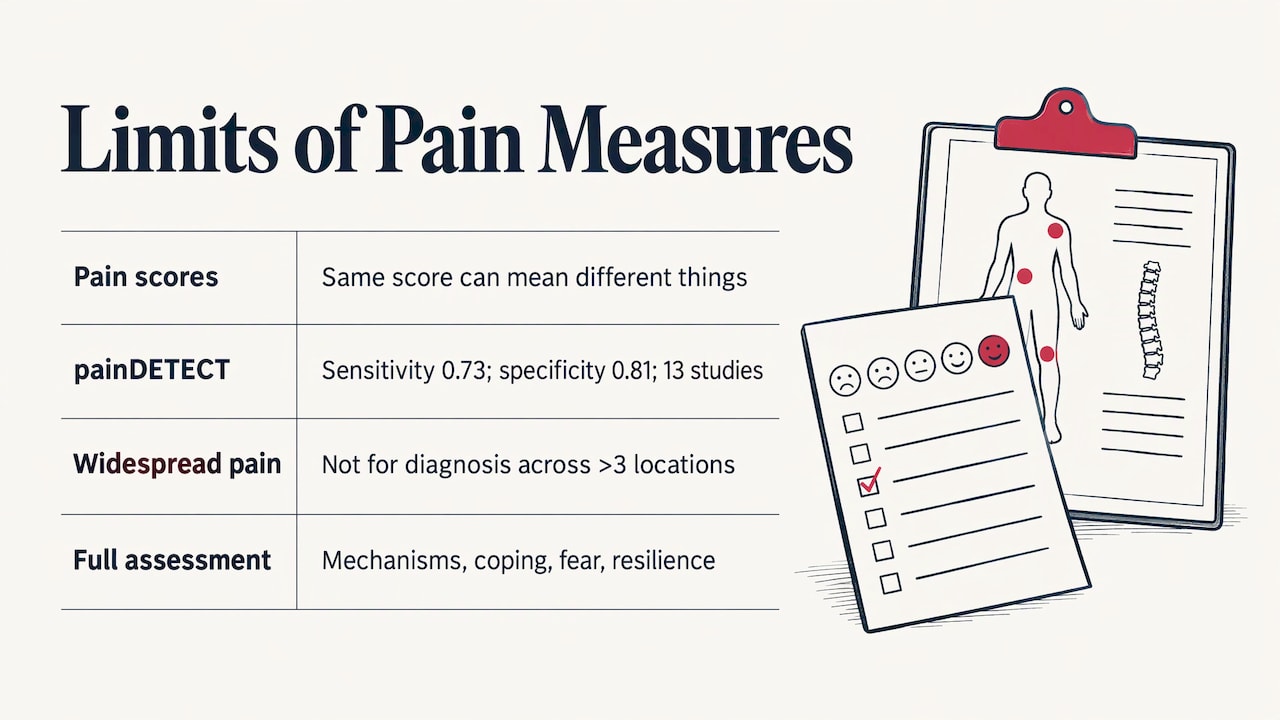
Numeric and visual pain scales are quick, and clinicians rely on them. But the 2022 practical guide points out that they have limits in chronic pain precisely because they are subjective and depend on a patient’s ability to report pain accurately and reproducibly. Two people can both say “7” and mean very different things. The same person can say “7” on Monday and “5” on Friday for reasons unrelated to any treatment.
Screening questionnaires have their own boundaries. The 2023 European guidelines on neuropathic pain report a pooled sensitivity of 0.73 and specificity of 0.81 for painDETECT across 13 studies, and they advise that these questionnaires are not meant for diagnosis in people with widespread pain across more than three locations. In plain terms, a questionnaire can point a direction. It cannot settle the question.
The same 2020 review argues that assessing location, severity and quality alone cannot tell the full story. A complete picture also covers pain mechanisms, coping, fear of movement and resilience. Mechanisms is the key word. When your care team can see something about the biology driving your pain, the plan can be more targeted.
If you have felt that conventional treatment keeps circling without landing, this is often why: the inputs were all subjective. Objective data does not make your experience less real. It gives it a second witness.
Where immune markers come in
The immune system and the nervous system talk to each other constantly. Immune signaling molecules called cytokines can influence how pain nerves fire and how long pain lingers. Our articles on cytokines and chronic pain and on the immune system and pain explain that connection in more depth.
The research literature supports looking here. A January 2026 umbrella review in the Journal of Clinical Medicine, which pulled together 49 systematic reviews and meta-analyses, found that inflammatory biomarkers including CRP, IL-6 and TNF-α showed the most consistent associations with chronic musculoskeletal pain. It also found that multi-protein panels showed exploratory diagnostic potential, particularly for fibromyalgia. A 2021 narrative review of 75 manuscripts on biomarkers in urine, blood, spinal fluid and saliva concluded that specific biomarkers may help identify patients at risk of disease development and serve as prognostic indicators.
That is the idea behind blood-based pain testing: measure what the immune system is doing, and use it as one more input. For a primer on terms like “biomarker,” read Pain Biomarkers: What They Are and What They Can Show. If you are curious how genetic and blood-based approaches differ, DNA testing for chronic pain covers it.
How clinicians put results to work
A result matters only if it changes what happens next. Here is how data typically feeds a plan.
Set a baseline
The 2022 practical guide recommends completing pain measures at the first consultation to establish a baseline. A baseline turns “I feel a little better” into a comparison. A blood result can sit alongside your questionnaires as part of that starting picture.
Choose realistic goals
The same guide notes that in research, a reduction of roughly 30% in perceived pain is considered clinically meaningful, and that realistic goals should be monitored regularly. Goals do not have to be “zero pain.” The AAFP Chronic Pain Toolkit says periodic reassessment should track physical health, mental and emotional health, progress toward functional goals, and how well medications work and are tolerated. Being able to walk the dog, sleep through the night or return to work counts as progress.
Match treatment to the likely drivers
When a pain picture points toward an immune or inflammatory contribution, that is something to raise with your provider when discussing options. Our guide to chronic pain treatment planning shows how to organize those discussions, and emerging pain treatments lists questions worth bringing to the appointment.
Reassess on a schedule
Pain changes. Reassessment keeps the plan honest. The AAFP toolkit states that assessment should be multidimensional, covering physiology, function, quality of life and mental and emotional health. Objective markers are one part of the physiology piece.
Reading your results with your doctor
A test result is a conversation starter, not a verdict. A few habits make the conversation better.
- Bring the whole picture. Your symptom history, medication list, prior imaging and any questionnaire scores belong in the room together with the new result.
- Ask what it changes. Good questions: Does this point toward a different treatment? Should we retest later to see movement? Which specialist should see this?
- Keep function in view. The NICE guideline on chronic pain (NG193), from the UK, notes that quality of life can improve even when pain stays the same. Goals around daily life matter as much as the number.
- Expect your experience to be taken seriously. The same NICE guideline advises clinicians to be careful not to invalidate a person’s experience when talking about test results. Objective data should support your account, never replace it.
If you have new or worsening symptoms such as weakness, loss of bladder or bowel control, fever with back pain, or numbness spreading quickly, contact your doctor right away or seek emergency care. Those need prompt evaluation, whatever any test says. Do not change or stop prescribed medication on the basis of a test result without talking to the clinician who prescribes it.
If you suspect nerve-related pain, our article on neuropathic pain testing explains how exams, nerve studies and blood tests fit together.
For providers: adding a biological layer
Clinicians who already screen with PEG, PHQ-2 and similar tools know how much the patient report carries. A biological marker panel lets you add an objective data point to the chart without a procedure beyond a blood draw. The Pain Signal Test™ was developed from peer-reviewed DNA research at a leading U.S. university and is aimed at the immune factors often overlooked in chronic pain. Results are meant to inform conversation between you and the patient and help chart next steps. Patients can order it directly or through a provider.
Getting the test
The Pain Signal Test™ is a chronic pain diagnostic blood test. It measures immune system markers linked to pain and gives patients and their healthcare providers objective results to guide pain management decisions. The process starts with a simple blood draw.
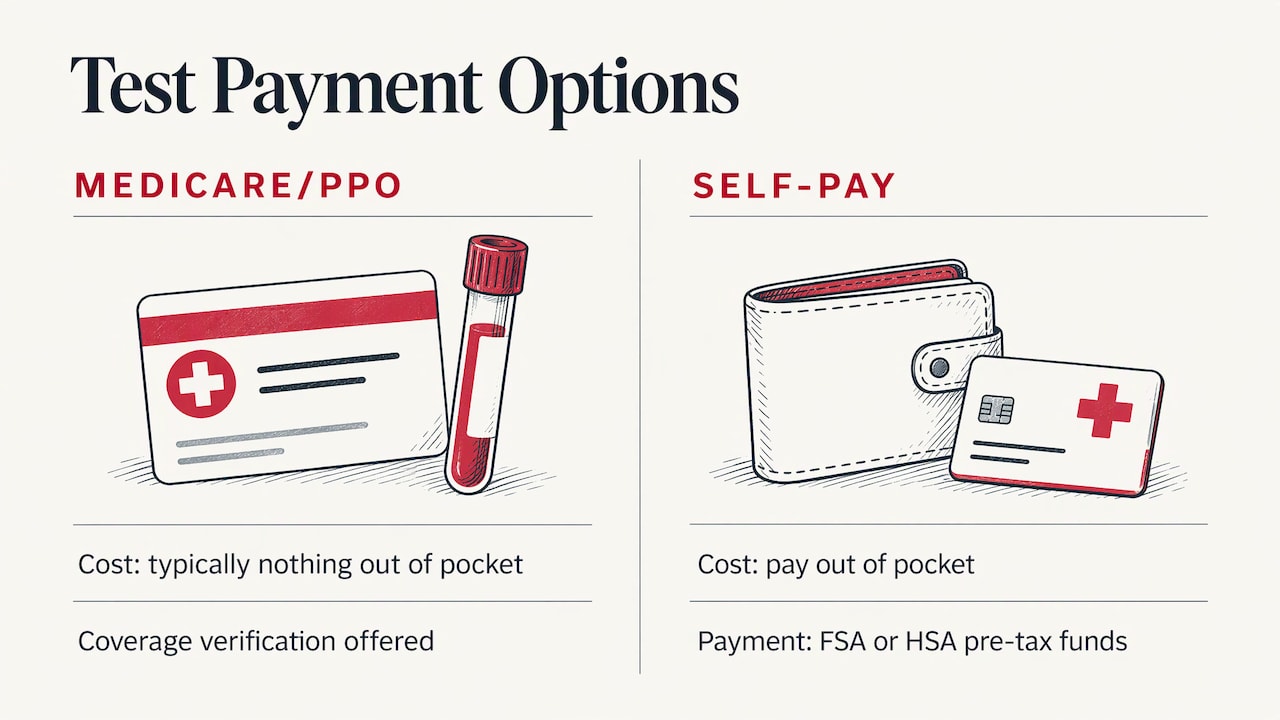
Cost is where many people expect a barrier. Patients covered by Medicare or PPO insurance typically pay nothing out of pocket, and we offer coverage verification so you know where you stand. For patients who pay on their own, the test can be paid for out of pocket or with FSA or HSA pre-tax medical funds.
If you have been frustrated by treatment that feels like guesswork, The Pain Signal Test™ is a practical way to start your next appointment with data.

Why we built around immune markers
Most of the people we hear from have been told some version of “your scans look fine.” Their pain is real, and the missing piece is information about what the body is doing. The Pain Signal Test™ was designed to supply that piece. It rests on peer-reviewed DNA research from a leading U.S. university and looks at immune system factors that are often overlooked in chronic pain.
We believe objective data changes the quality of the conversation between patient and provider. A number from a blood draw does not argue with your experience. It gives your doctor something concrete to work with, so next steps can be chosen instead of guessed.
We also think access matters. That is why we verify coverage, and why patients with Medicare or PPO insurance typically pay nothing out of pocket. Information that guides pain care should not sit behind a bill.
the author
FAQ
What is test-informed pain management?
It is an approach where treatment decisions draw on measured information as well as your description of symptoms. That includes your history, a physical exam, validated questionnaires and diagnostic tests. The goal is a plan matched to what is driving your pain.
Can a blood test show why I have chronic pain?
A blood test can show biological markers associated with pain, such as immune system factors. Research links inflammatory markers like CRP, IL-6 and TNF-α with chronic musculoskeletal pain. The Pain Signal Test™ measures immune markers linked to pain so you and your provider can discuss what the results mean for next steps.
Will insurance pay for The Pain Signal Test™?
Patients covered by Medicare or PPO insurance typically pay nothing out of pocket, and coverage can be verified before you proceed. Patients who pay themselves can use out-of-pocket funds or FSA and HSA pre-tax medical accounts.
Do I need a doctor to order it?
You can order the test directly or through your healthcare provider. In either case, bring the results to your provider so they can be read alongside your history, exam and other findings.
How often should pain be reassessed?
There is no single schedule that fits everyone. The AAFP toolkit says reassessment should be periodic and track physical and mental health, functional goals and medication tolerability. Your provider can set the interval based on your plan.
Sources
- A practical guide to recognize, assess, treat and evaluate chronic pain (2022)
- NIH Pain Consortium: Pain Assessment Resources for Professionals
- Measures for the Assessment of Pain in Adults, Arthritis Care & Research (2020)
- ACOEM: Diagnostic Tests for Low Back Disorders (2019)
- Joint EAN/EPF/NeuPSIG guidelines on neuropathic pain (2023)
- Neurophysiological, Radiological, and Molecular Biomarkers, Journal of Clinical Medicine (2026)
- How Well Do Current Laboratory Biomarkers Inform Clinical Decision-Making (2021)
- AAFP Chronic Pain Toolkit
- NICE NG193: Chronic pain (primary and secondary) in over 16s