
Personalized Pain Management: How to Build a Plan Around You

Personalized pain management means your care is fitted to you: your pain type, your history, your goals and, increasingly, your biology. If years of standard treatment have not worked, the missing piece is often objective information about what is driving your pain. The Pain Signal Test™ is a blood test that looks at immune system factors linked to chronic pain, so you and your doctor can start from data instead of guesswork.
TL;DR
- No treatment works for every type of pain or every person, which is why the NIH says care must be personalized.
- A personalized plan combines several approaches, tracks results, and gets adjusted over time.
- Scans and exams do not always explain pain, so many patients and clinicians look for additional biological information.
- The Pain Signal Test™ measures immune system markers tied to chronic pain with a simple blood draw, and typically costs eligible Medicare or PPO patients nothing out of pocket.
- Bring your results, a symptom diary and clear goals to your next appointment.
Table of Contents
- What personalized pain management actually means
- Why standard care sometimes stalls
- The building blocks of an individualized plan
- How to track whether your plan is working
- Where a blood test fits
- For clinicians
- Our perspective
- Get your own data
- FAQ
- Sources
What personalized pain management actually means
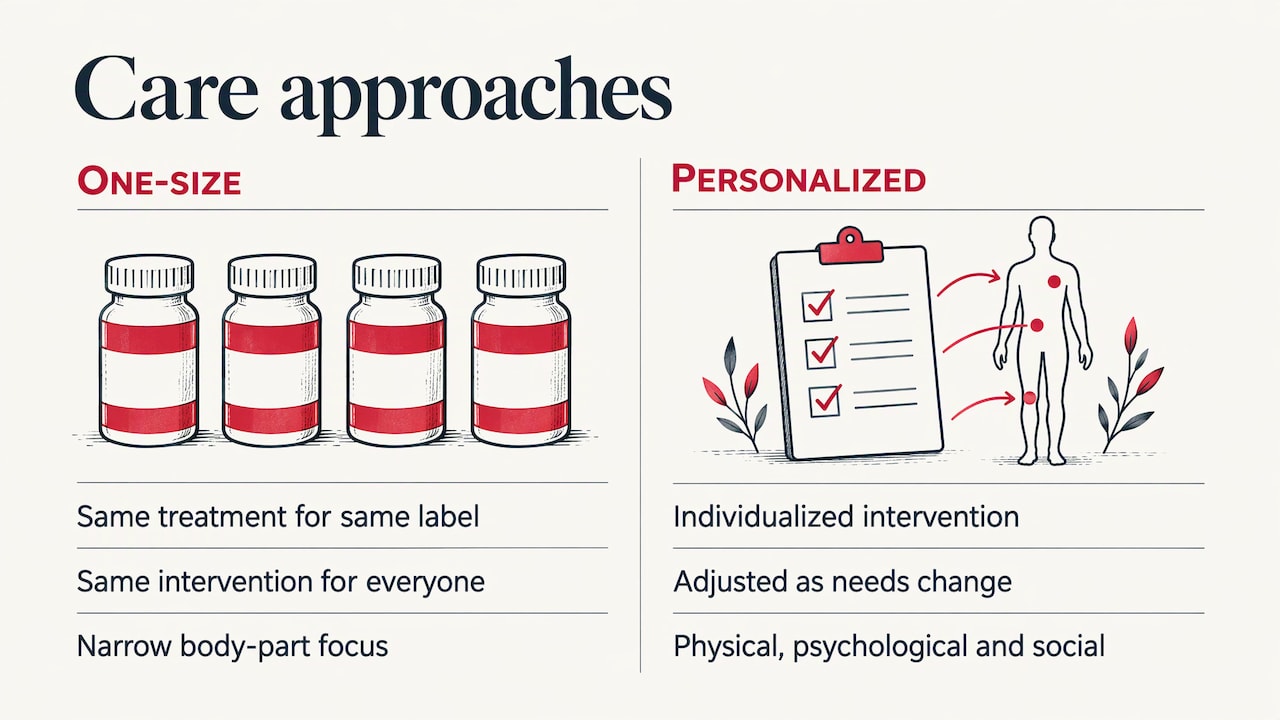
A one-size-fits-all approach gives the same treatment to everyone with the same label, such as “low back pain” or “fibromyalgia.” A personalized approach tailors treatment to the individual. A 2024 academic review describes two levels of personalization: between patients, where each person gets an individualized intervention, and within one patient, where the plan is adjusted as needs change.
Why does this matter? The same review cites a rheumatoid arthritis study in which expressing emotions was linked to lower pain in less extroverted patients but the opposite effect in more extroverted ones. The same intervention helped one group and not another.
The U.S. Department of Veterans Affairs adds that a narrow focus on one body part or one aspect of pain can lead to unsafe and ineffective treatment. Its whole-person model treats pain as a physical, psychological and social experience.
Why standard care sometimes stalls
Many people with chronic pain have followed the usual path: imaging, a medication trial, physical therapy, maybe an injection. When none of it fully works, the problem is often that the cause was never pinned down.
Imaging has real limits. Pain Australia’s clinical assessment factsheet notes there is no one-to-one relationship between imaging findings and pain: severe degenerative changes can exist without pain, and pain can exist without visible changes. A U.S. assessment document based on VA/DoD guidance likewise says pathology found on a test does not necessarily prove it causes the pain.
The American Pain Society’s monograph explains that tests are chosen by pain characteristics and the suspected condition, and that they supplement rather than replace a thorough history and exam. That is the right frame: no single test is the answer, but the right additional data can change the conversation.
If this sounds like your story, our guide on undiagnosed chronic pain walks through what to do next.
The building blocks of an individualized plan
A strong plan has five parts.
1. A thorough assessment
The PATIENT Approach, a 2023 clinical framework, recommends recording age, body weight, comorbidities, genetic status and previous pain medication use, and asking about the four Ws of pain: where it is, when it occurs, what it feels like (burning, stabbing) and why you think it happens. Come prepared to answer each.
2. Biological and phenotyping data
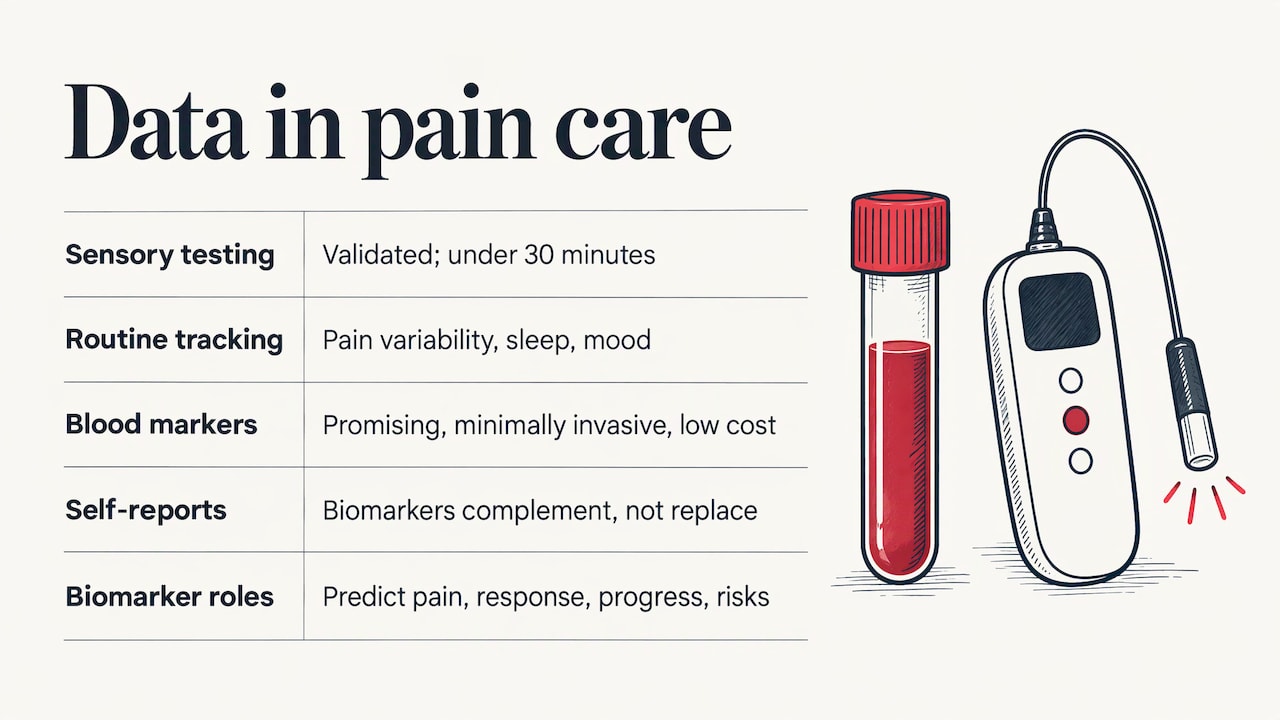
Researchers working on precision pain care recommend using validated measures to classify patients, including quantitative sensory testing that can be done in under 30 minutes, plus routine tracking of pain variability, sleep and mood. Blood-based markers are part of this picture too. A 2025 review reports that blood biomarkers such as cytokines are promising because they are minimally invasive and low cost, and that they are meant to complement self-reports rather than replace them.
That same review describes several jobs biomarkers can do in pain care: predicting who will keep having pain, identifying who will respond to a treatment, monitoring progress and flagging safety risks. To understand the concept in plain terms, see pain biomarkers.
3. A multi-treatment strategy
The NIH recommends a whole-person approach in which non-medicine therapies and non-opioid medicines are often used first or alongside other options, with a team that can include primary care providers, pain specialists, nurses, mental health clinicians, therapists, pharmacists and social workers. Treatment choice is often guided by pain quality: inflammatory, nociceptive and neuropathic pain respond to different drug classes, each with its own safety considerations your prescriber will review with you.
Physical health, mental health, relationships and daily circumstances all shape pain. Integrated wellness settings, such as a clinic that addresses muscle and joint pain within a broader holistic program, reflect that whole-person thinking.
4. Shared goals
NICE’s chronic pain guideline, published 7 April 2021, recommends agreeing a care and support plan that covers your priorities, goals and preferred treatments. Goals work best when they are about function: walking a mile, sleeping through the night, returning to work.
5. Monitoring and adjustment
A plan that never changes is not personalized. The next section covers how to track it.
For a fuller walkthrough, read our guide to chronic pain treatment planning.
How to track whether your plan is working
Tracking turns a hunch into evidence you can use in the exam room.
- Keep a diary. France’s 2025 fibromyalgia guideline recommends recording pain changes, impact on daily activities, coping methods and mood between consultations, for a few months.
- Use shared questionnaires. The same guideline suggests reassessing with common tools such as the Fibromyalgia Impact Questionnaire and PHQ-9, a short mood questionnaire.
- Expect more frequent follow-up early on. It suggests visits be more frequent at first, then every 3 to 6 months once things are improving.
- Report flare-ups and new symptoms. NICE recommends offering reassessment when symptoms change, such as during a flare-up.
- If you take opioids, keep every visit. A patient guide from the American Institutes for Research advises attending visits every 1 to 3 months even when you feel well, reporting how often you take doses, and sharing side effects. If pain is not improving in the expected time, schedule a visit to discuss adjustments.
Never stop or reduce a prescribed opioid on your own. The VA/DoD guideline says that, when safe, tapering is gradual, around 5 to 20 percent every 4 weeks or longer, and individualized to your goals and safety. Your prescriber should plan it with you.
Where a blood test fits
Here is the gap many patients describe: they know their pain is real, but nothing on paper shows why. Clinicians themselves acknowledge that physical examination alone is limited, because clinical tests have variable sensitivity and specificity and can depend on the examiner. Objective biological information adds another view.
The Pain Signal Test™ is built for this. It is a blood draw that measures immune system markers associated with chronic pain, developed from peer-reviewed DNA research at a leading U.S. university. Immune involvement is an often-overlooked factor in chronic pain, and results give you and your healthcare provider objective information to discuss and use in charting next steps.
To see how this kind of data is used, read about objective pain data and what a blood test for pain can show. If nerve pain is your concern, see neuropathic pain testing. For the genetic side, there is a guide to DNA testing for chronic pain.
Making the results count
Results are most useful when they land in a good conversation. Before your appointment:
- Write down your goals in terms of daily function.
- Bring your diary and a list of treatments already tried, with what happened.
- Share your results and ask how they might shape the next step in your plan.
- Agree on when you will reassess.
If you struggle to be heard, our piece on chronic pain patient advocacy offers practical language. And if you are curious about newer options to raise with your clinician, see emerging pain treatments.
For clinicians
The RATE guide for pain assessment recommends brief validated self-report tools to identify pain subtypes and cautions that many patients carry forward incorrect diagnoses that perpetuate inappropriate treatment, so independent assessment matters. Objective biological data can add to that independent picture. The Pain Signal Test™ gives you immune marker results from a single blood draw to consider alongside history and exam, and your patients can order it directly or through you.
Our perspective
Pain is not a character flaw and it is not all in your head. For too long, people with chronic pain have been handed a trial-and-error process with little biology behind it.
We believe personalized care starts with better information. Immune system factors are often overlooked in chronic pain, and that is the gap The Pain Signal Test™ was designed to address, using peer-reviewed DNA research from a leading U.S. university.
When patients arrive at an appointment with objective results, the conversation changes. It becomes about what the data suggests and what to try next, together with your healthcare provider.
the author
Get your own data
The Pain Signal Test™ is a simple blood draw that looks at immune system markers linked to chronic pain. Patients with Medicare or PPO coverage typically pay nothing out of pocket, and coverage can be verified. The test can also be paid for through eligible FSA or HSA accounts.

Learn more and start at The Pain Signal Test™.
FAQ
Is personalized pain management the same as precision medicine?
They overlap. Precision medicine uses biological markers to guide treatment, while personalized pain management also includes your goals, preferences, mental health and life circumstances. The best plans use both.
Can a blood test diagnose chronic pain?
No single test diagnoses chronic pain on its own; tests work alongside your history and exam. Researchers describe blood-based markers as promising complements to self-reports. The Pain Signal Test™ provides objective information about immune markers to support those discussions.
How often should my plan be reviewed?
There is no universal schedule. Guidance suggests more frequent follow-up at the start, then every 3 to 6 months once you are improving, and sooner if symptoms change or a flare-up occurs. Ask your clinician to set the next review date at each visit.
Will insurance cover The Pain Signal Test™?
Patients with Medicare or PPO coverage typically pay nothing out of pocket, and coverage verification is part of the process. Eligible FSA and HSA funds can also be used.
Sources
- NIH: Pain
- Moving Beyond One-Size-Fits-All (Journal of Pain Research, 2024)
- VA: Whole Person Pain Care
- Pain Australia: Clinical Assessment of Pain
- Assessment and Management of Chronic Pain
- American Pain Society: Pain Monograph
- The PATIENT Approach (2023)
- Optimizing and Accelerating the Development of Precision Pain Treatments (IMMPACT, 2022)
- Innovations in acute and chronic pain biomarkers (2025)
- NICE NG193 chronic pain guideline
- HAS fibromyalgia guideline 2025
- AIR: Communicating With Your Provider
- VA/DoD Opioid Therapy Provider Summary
- RATE guide (Gebke et al.)